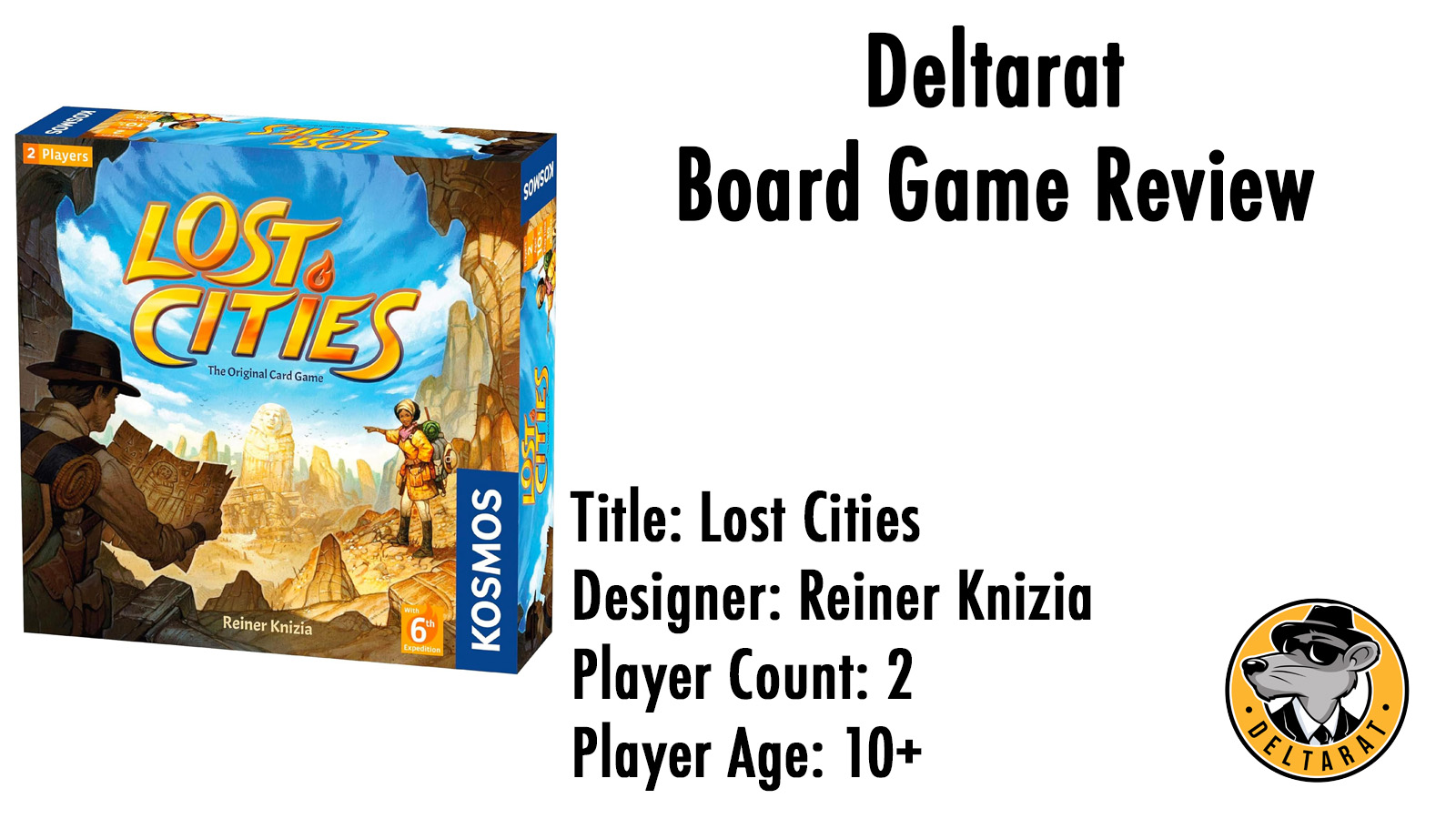
Lost Cities - An Overview
Lost Cities is an amazing two-player game that is quick to set up, easy to learn, and fun to play. I own the original version, but a newer version is available. I’ll talk a little about the differences later. First, let me tell you a little about how it plays.
Lost Cities - How It Plays
If you’ve read some of my other board game reviews, you know that when I talk about how a game plays, I’m not trying to teach you the rules. There are plenty of other places online that do a great job of that. You can even watch videos that show you exactly how to play. Instead, I like to describe what makes the game fun.
Lost Cities is surprisingly strategic given how simple the rules are. Some may say it’s mostly about random card draws, but the more you play, the more you realize that’s not the case. You begin to discover strategies and ways to approach the game.
Lost Cities - What Makes It Fun
Lost Cities is for two players only. This one-on-one play makes it a game about reading your opponent. It’s not uncommon to have thoughts going through your head like, “Do I know what they’re doing? I think so. Should I play this card to make them think I don’t know what they’re doing? Wait! Do they know what I’m doing?”
There is also a heavy press-your-luck aspect to Lost Cities. At the same time, you don’t want to back down. You have to decide if you’re going to continue pushing forward to score more points or relent and allow your opponent to have a card they need in order to possibly gain a card you need.
“Wait a minute,” I hear you say. “Did you just say ‘allow your opponent to have a card they need’?” Yes, I did. This is one of the things that makes Lost Cities such an amazing and, sometimes, frustrating game.
You can only hold eight cards in your hand. Here’s the thing. Eight cards never seems to be enough. Without getting too far into the rules, you have to play cards in a certain order to score points. So, you may find yourself holding cards while waiting to draw other specific cards that you want to play first.
At the same time, you may be holding cards that you know your opponent could use. At the end of your turn, you have to discard a card. This is the part that makes Lost Cities so brilliant in its simplicity. When you discard a card, your opponent can draw it on their turn! That means you can give your opponent the cards they need to score more points. If you lose the game, there’s a good chance your opponent beat you using cards you gave them!
“Why would you do such a thing?” I hear you ask again. Because, as I mentioned before, you can only hold eight cards. You may be holding cards that you don’t need, but you know your opponent does. Those cards are taking up space in your hand—space that could be used for cards you need.
So, you have to decide. Am I going to give in and give my opponent a card they need, or am I going to hold on to it, keeping it from them but making it more difficult to get the card I need? Remember, your opponent is struggling with the same questions while holding cards you need. It’s just so diabolical!
Sometimes, something happens that makes the card you’ve been holding completely useless to your opponent. It’s funny when you’ve been holding that card the whole game, your opponent has been waiting on you to discard it, and then something happens that makes it useless to them. On your very next turn, you discard it!
The look on their face at that point makes the whole game worth playing.
Lost Cities - Things to Consider
There are a few things to consider with Lost Cities. As mentioned, it’s only a two-player game. So, if you’re with a larger group and want to play Lost Cities, you may need to get another game going at the same time for everyone else. That’s not really a bad thing, just something to keep in mind.
I mentioned earlier that I own the original version of Lost Cities, but there is a newer version available. If you’re buying the game today, the newer version is the one I would get. The game relies on being able to distinguish the different colored cards and their discard locations on the board. In the original version, some of the colors on the board can be a little difficult to see. The newer version improves this dramatically.
The newer version also adds symbols to the cards, making the game easier to play for color-blind players.
The newer version also adds a sixth expedition. The original game is played with five different colors, or expeditions. With the two-sided board included in the newer version, you can choose between the original five-color game and a six-color version.
The six-color version makes scoring points a little easier, but I still prefer playing with the original five colors. The nice thing about the newer version is that you can choose whichever way you prefer.
Another thing to consider is the scoring in Lost Cities. There are a couple of things that are easy to forget when it comes time to add up your scores.
One is this. When you start an expedition, it costs you twenty points. So, the first twenty points you score for that color simply gets you back to zero. You have to score more than twenty points on an expedition before it actually adds to your final score.
The other is remembering that any expedition that has at least eight cards played on it earns an additional twenty points. It’s easy to simply add up the cards at the end of the game and forget about these two things.
There are a few other things that affect scoring, such as the wager cards, but my point isn’t to teach you how to score the game. Just make sure you check the scoring rules in the rulebook the first few times you play. After you’ve done it a couple of times, you probably won’t need to look at them anymore.
Lost Cities - Conclusion and Rating
It amazes me that a game so simple, with a rulebook that is barely four pages and components that are basically just cards and a board, can be so incredibly fun. I’ve never played this game just once. Every person I’ve played Lost Cities with has wanted to shuffle the cards and play again immediately afterward. It really is that enjoyable.
It’s a small game. It travels well. It’s quick to play. For these reasons and many more, I will always have a copy of Lost Cities on my shelf. I may even break down and get the newer version just in case I want to play with six colors instead of the standard five.
I don’t usually say a game needs to be in a gamer’s collection, but Lost Cities needs to be in your collection.

Find It Here
View ProductAffiliate link — I may earn a commission from qualifying purchases at no additional cost to you.